


National
17 NOVEMBER CURRENT AFFAIRS
1. International Maritime Organization (IMO)
The International Maritime Organization (IMO) is a specialised agency of the United Nations responsible for improving the safety and security of international shipping and preventing marine and atmospheric pollution caused by ships. Its headquarters is located in London, United Kingdom.

Establishment and Objectives
- The IMO Convention was adopted on 6 March 1948 at an international conference held in Geneva, Switzerland.
- It entered into force on 17 March 1958, and the organisation held its first meeting in January 1959.
- Initially established as the Inter-Governmental Maritime Consultative Organization (IMCO), it was renamed the International Maritime Organization in 1982.
- It currently has 176 Member States.
Major Functions
- Maritime Safety: Develops international standards to prevent accidents and protect lives at sea.
- Marine Environment Protection: Works to prevent pollution from ships, including oil spills and greenhouse gas emissions.
- Maritime Security: Addresses piracy, armed robbery and other threats to shipping.
- Legal Framework: Develops international conventions concerning maritime liability, compensation and navigation.
- Technical Cooperation: Supports developing countries in strengthening maritime administration and infrastructure.
Important Conventions
- SOLAS (1974): International Convention for the Safety of Life at Sea.
- MARPOL (1973/1978): Convention for the Prevention of Pollution from Ships.
- STCW (1978): Standards of Training, Certification and Watchkeeping for Seafarers.
The IMO plays a crucial role in regulating global maritime transport, which carries a major share of international trade. It contributes to safer navigation, cleaner oceans and sustainable maritime development.
2. National Health Accounts (NHA) Estimates 2023–24
The National Health Accounts (NHA) Estimates 2023–24, released by the Ministry of Health and Family Welfare on 15 November 2026, provide an overview of India's healthcare expenditure and financing patterns. The report is the eleventh edition of the National Health Accounts series and follows the internationally recognised System of Health Accounts 2011 (SHA 2011) framework.
Key Findings
- Total Health Expenditure (THE): Estimated at ₹9.52 lakh crore, equivalent to 3.29% of GDP.
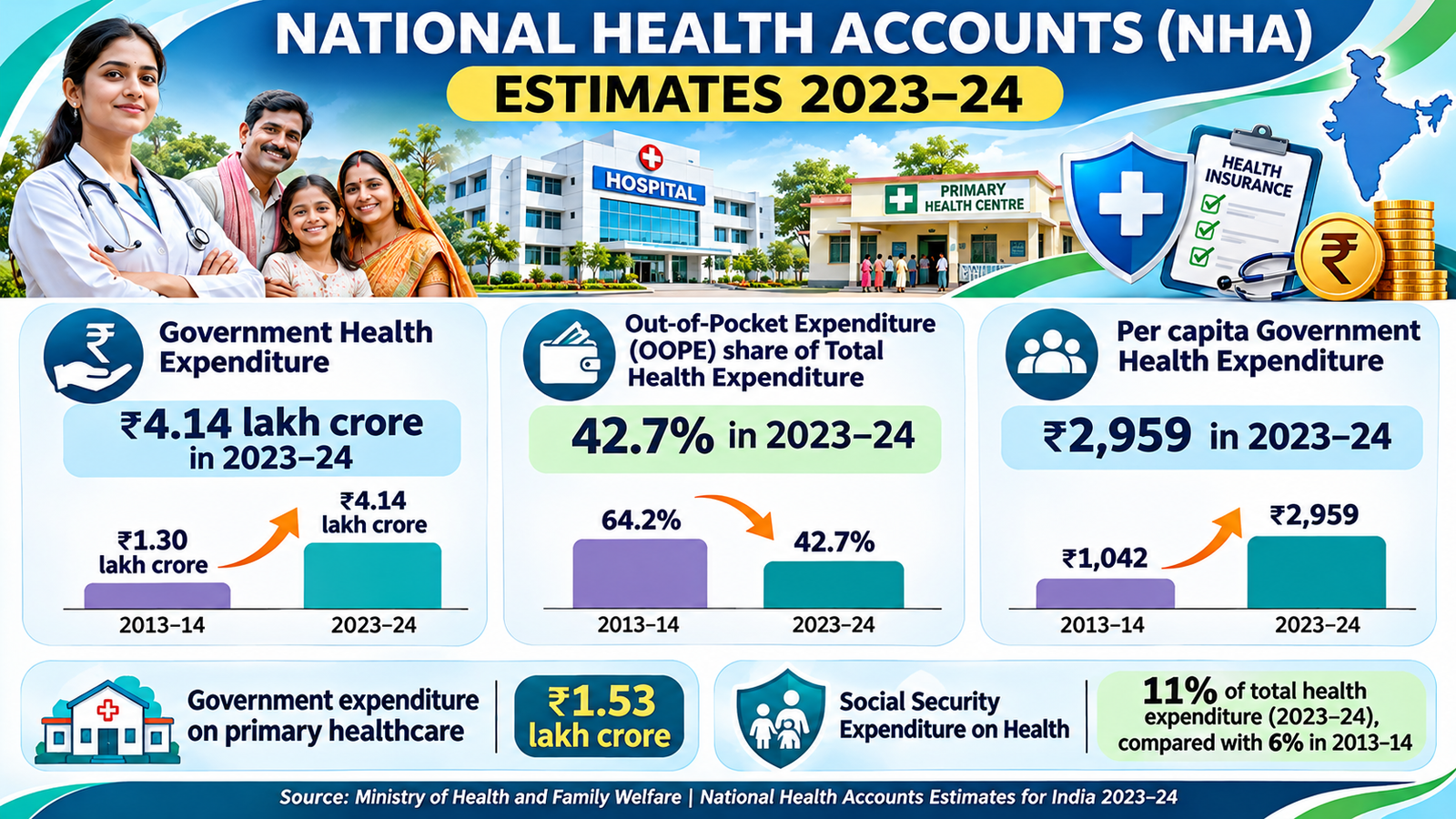
- Government Health Expenditure (GHE): Increased from ₹1.30 lakh crore in 2013–14 to ₹4.14 lakh crore in 2023–24, accounting for 43.5% of total health expenditure.
- Out-of-Pocket Expenditure (OOPE): Declined from 64.2% in 2013–14 to 42.7% in 2023–24, reducing the direct financial burden on households.
- Per Capita Government Health Expenditure: Increased from ₹1,042 to ₹2,959 during the same period.
- Social Security Expenditure: Its share of total health expenditure rose from 6% to 11%.
- Primary Healthcare: Government expenditure reached approximately ₹1.53 lakh crore in 2023–24.
Significance
The findings indicate a gradual shift towards greater public financing of healthcare. Initiatives such as Ayushman Bharat–PM-JAY, Ayushman Arogya Mandirs, Pradhan Mantri Bhartiya Janaushadhi Pariyojana and free drugs and diagnostics services support affordable healthcare access.
Challenges
Despite progress, OOPE remains substantial. High medicine costs, limited public healthcare infrastructure, uneven access to quality services and shortages of healthcare professionals continue to affect affordability and accessibility.
The NHA estimates provide an important evidence base for strengthening India's healthcare financing system and advancing Universal Health Coverage (UHC).
3. Challenges to the Quad’s Strategic Cohesion
Introduction
The Quadrilateral Security Dialogue (Quad) is an informal strategic grouping comprising India, the United States, Japan and Australia. It aims to promote a free, open, inclusive and prosperous Indo-Pacific region. Initially emerging from cooperation during the 2004 Indian Ocean tsunami, the Quad was formally initiated in 2007 and revived in 2017 amid growing geopolitical competition and China's increasing influence in the Indo-Pacific.
Despite its strategic importance, differences in national interests, security priorities and foreign policy approaches have created challenges to its long-term cohesion.

Major Challenges to the Quad
- Divergent Strategic Priorities: The United States and Japan focus considerably on the Taiwan Strait and the East and South China Seas, while India's primary strategic concerns include the Indian Ocean Region and its continental border with China. Australia's priorities also extend to the Pacific Islands.
- Different Approaches towards China: Although all four countries recognise concerns associated with China's growing influence, they differ in their willingness to adopt a confrontational approach. India prefers strategic autonomy, while Japan and Australia generally support stronger security coordination.
- Lack of Institutionalisation: The Quad has no permanent secretariat, binding treaty or collective defence mechanism. Its activities depend heavily on political commitment and leadership-level engagement.
- Uncertainty in US Foreign Policy: Changing American priorities, trade disagreements and shifting diplomatic approaches towards China create uncertainty among other members about Washington's long-term regional commitment.
- Economic Interdependence with China: All four members maintain significant economic and trade relations with China, making complete economic decoupling difficult.
- Overlapping Strategic Groupings: Initiatives such as AUKUS and other regional partnerships create additional strategic frameworks, potentially affecting the Quad's centrality.
Significance for India
The Quad strengthens India's maritime security, access to advanced technologies, resilient supply chains and cooperation with major Indo-Pacific powers. Initiatives involving maritime domain awareness, critical minerals, infrastructure development and disaster management complement India's Act East Policy and Indo-Pacific Oceans Initiative.
However, India must ensure that participation does not compromise its strategic autonomy or adversely affect relations with ASEAN countries and other strategic partners.
Way Forward
The Quad should prioritise practical cooperation over rigid military alignment. Strengthening maritime surveillance, critical mineral supply chains, digital infrastructure, disaster response and technology partnerships can produce measurable outcomes. Regular high-level consultations and greater coordination among member countries are also essential.
Conclusion
The Quad's effectiveness depends not on becoming a formal military alliance but on maintaining strategic convergence despite differing national interests. A flexible, inclusive and outcome-oriented approach can strengthen its relevance as an important pillar of Indo-Pacific stability.
FACTS TO KNOW:
Eklavya Model Residential Schools (EMRS)
- Eklavya Model Residential Schools are a flagship initiative of the Ministry of Tribal Affairs, launched in 1998 to provide quality residential education to Scheduled Tribe students, particularly those living in remote areas.
- The schools provide education from Class VI to Class XII and aim to improve access to quality education for tribal children.
- The programme was revamped in 2018–19 to expand its coverage and improve school infrastructure.
- Under the revised framework, EMRSs are to be established in blocks having more than 50% Scheduled Tribe population and at least 20,000 tribal persons.
- The National Education Society for Tribal Students (NESTS) is an autonomous organisation under the Ministry of Tribal Affairs responsible for establishing and managing EMRSs.
- EMRSs are co-educational residential schools that follow the CBSE curriculum and provide free education.
- Each school has a sanctioned capacity of 480 students, with equal seats for boys and girls.
- The schools provide hostels, classrooms, playgrounds, sports facilities and skill-development opportunities.
- They also promote the preservation of tribal art, culture and traditional knowledge.
- Up to 10% of seats may be available to non-ST students, while 20% of seats are earmarked under the sports quota for deserving ST students who have excelled in sports.
- Recent development: Four newly constructed EMRSs were inaugurated in Tripura on the occasion of the 151st birth anniversary of Bhagwan Birsa Munda.
- NESTS has partnered with the Learning Links Foundation to introduce the Amazon Future Engineer programme, which aims to strengthen technology and computer-science education for tribal students.
Yamuna River
- The Yamuna is the largest and one of the most important tributaries of the Ganga River.
- It originates from the Yamunotri Glacier in the Bandar Poonch range of the Uttarakhand Himalayas, at an elevation of approximately 6,387 metres.
- The river is approximately 1,376 km long and flows through Uttarakhand, along the Haryana–Uttar Pradesh region, through Delhi and Uttar Pradesh, before joining the Ganga at Prayagraj.
- The confluence of the Ganga and Yamuna at Prayagraj is known as the Triveni Sangam, traditionally associated with the mythical Saraswati.
- The Tons River is the largest tributary of the Yamuna and joins it in the Himalayan region.
- The Chambal is the largest right-bank tributary of the Yamuna.
- Other important tributaries include the Sindh, Betwa, Ken, Hindon and Giri.
- The Western Yamuna Canal and Eastern Yamuna Canal are important irrigation canals that draw water from the river system.
- The Agra Canal also receives water from the Yamuna near Delhi.
- Important cities along the river include Delhi, Mathura, Vrindavan, Agra, Etawah and Prayagraj.
- The Yamuna is a major source of water for domestic, agricultural and industrial activities in northern India.
- The Delhi stretch is severely polluted due to untreated sewage, industrial effluents and inadequate wastewater treatment.
- Water quality often improves temporarily during the monsoon because increased river discharge dilutes and flushes out some pollutants; this does not resolve the underlying pollution problem.
- Recent development: A four-pronged cleaning drive has been announced to restore the river, with a target of improving its condition within three years.
Lakhpati Didi Initiative
- The Lakhpati Didi Initiative was announced on 15 August 2023 to promote the economic empowerment of rural women associated with Self-Help Groups (SHGs).
- It is implemented through the institutional framework of the Deendayal Antyodaya Yojana–National Rural Livelihoods Mission (DAY-NRLM).
- The nodal ministry is the Ministry of Rural Development.
- A Lakhpati Didi is a woman belonging to an SHG household who earns an annual household income of at least ₹1 lakh, sustained over time.
- The initiative aims to help rural women establish micro-enterprises and diversify their sources of income.
- The original target of two crore women was increased to three crore in the Interim Budget of 2024–25.
- The target was subsequently raised to six crore Lakhpati Didis by March 2029.
- It promotes livelihood activities such as agriculture, dairy farming, animal husbandry, food processing, handicrafts, tailoring and rural services.
- The initiative provides support through skill development, financial literacy, access to institutional credit, enterprise development and market linkages.
- A cascade training strategy is used to train and support potential Lakhpati Didis through community-level capacity building.
- DAY-NRLM helps organise rural women into SHGs and facilitates access to formal banking and sustainable livelihood opportunities.
- Recent progress: According to the November 2026 report, 3.76 crore Lakhpati Didis had been enabled as of June 2026.
Egypt
- Egypt is located in north-eastern Africa, with the Sinai Peninsula extending into south-western Asia.
- The Sinai Peninsula forms a land bridge between the African and Asian continents.
- Its capital is Cairo, situated along the Nile River.
- Egypt shares land borders with Libya to the west, Sudan to the south, and Israel and the Gaza Strip to the north-east.
- It has a coastline along the Mediterranean Sea to the north and the Red Sea to the east.
- The Gulf of Aqaba separates the Sinai Peninsula from Saudi Arabia.
- The Suez Canal, located in Egypt, connects the Mediterranean Sea with the Red Sea and provides an important maritime route between Europe and Asia.
- The Nile River flows from south to north through Egypt and supports agriculture, settlements and economic activities.
- The Nile Delta is located in northern Egypt, where the river divides into distributaries before entering the Mediterranean Sea.
- Much of Egypt consists of arid desert, including areas of the Sahara Desert.
- The fertile Nile Valley and Nile Delta support most of the country's population and agricultural activities.
- Mount Catherine, located in the Sinai Peninsula, is Egypt's highest peak at approximately 2,642 metres.
- Major natural resources include petroleum, natural gas, phosphates and iron ore.
- Recent development: India and Egypt held their seventh Joint Trade Committee meeting to strengthen bilateral trade and economic cooperation.
Pradhan Mantri Janjatiya Vikas Mission (PMJVM)
- The Pradhan Mantri Janjatiya Vikas Mission is a scheme of the Ministry of Tribal Affairs aimed at improving the livelihoods and economic conditions of tribal communities through the development and marketing of Minor Forest Produce (MFP) and other tribal products.
- It promotes tribal entrepreneurship by helping forest-produce gatherers move from selling raw materials to processing, value addition and organised marketing.
- The mission integrates initiatives relating to Minimum Support Price (MSP) for Minor Forest Produce and the marketing of tribal products.
- TRIFED (Tribal Cooperative Marketing Development Federation of India) is the central implementing agency for the mission.
- Minor Forest Produce includes mahua flowers, tamarind, honey, tendu leaves, lac, bamboo and medicinal plants.
- The government provides MSP for notified Minor Forest Produce to protect tribal gatherers from distress sales and exploitation by middlemen.
- The mission organises tribal gatherers into community-based Van Dhan Vikas Kendras (VDVKs) through Self-Help Groups.
- A VDVK generally consists of around 15 Van Dhan SHGs, with approximately 300 members. At least 60% of the members must belong to Scheduled Tribe communities.
- Van Dhan SHGs undertake the collection, processing, packaging and value addition of forest produce and other locally available products.
- Financial and technical assistance is provided for raw materials, training, processing machinery, storage, transportation, packaging and branding.
- The mission also facilitates market access through exhibitions, tribal fairs, e-commerce platforms and other marketing channels.
- The Van Dhan Yojana, launched on 14 April 2018, forms an important part of the VDVK-based livelihood model.
- Recent progress: As of March 2026, 4,172 VDVKs had been sanctioned, covering approximately 12.48 lakh tribal beneficiaries.
- The mission aims to strengthen tribal livelihoods, promote community-owned enterprises and ensure a greater share of the value generated from forest resources reaches tribal producers.
137th Birth Anniversary of Jawaharlal Nehru
- Jawaharlal Nehru was born on 14 November 1889 in Allahabad, now known as Prayagraj, Uttar Pradesh.
- His 137th birth anniversary was observed on 14 November 2026.
- He was India's first Prime Minister and served from 15 August 1947 until his death on 27 May 1964.
- His father was Motilal Nehru, a prominent lawyer and leader of the Indian National Congress.
- Nehru studied at Harrow School and Trinity College, Cambridge, and later trained as a barrister at the Inner Temple in London.
- He joined the Indian freedom movement under the influence of Mahatma Gandhi and became an important leader of the Indian National Congress.
- He was elected President of the Indian National Congress at the Lahore Session of 1929, where the resolution of Purna Swaraj (Complete Independence) was adopted.
- He played an important role in the freedom struggle and participated in several national movements, including the Non-Cooperation Movement and the Quit India Movement.
- Nehru became the first Prime Minister of independent India in 1947 and played a central role in shaping the country's parliamentary democracy, secular institutions and modern economic policies.
- He promoted scientific development, industrialisation, public-sector enterprises and the establishment of major scientific and educational institutions.
- He was a leading advocate of the Non-Aligned Movement (NAM) during the Cold War and supported peaceful coexistence and independent foreign policy.
- His important literary works include The Discovery of India, Glimpses of World History and An Autobiography (also published as Toward Freedom).
- His birthday is celebrated as Children's Day (Bal Diwas) in India to recognise his affection for children and his emphasis on their education and welfare.
- International Children's Day is observed on 20 November, which is different from India's Children's Day.
- Nehru received the Bharat Ratna in 1955.
Exercise Sea Vigil–2026
- Exercise Sea Vigil is a pan-India coastal defence exercise conducted to assess and strengthen India's maritime security and coastal defence preparedness.
- It was conceptualised in 2018, following the 26/11 Mumbai terrorist attacks, to test the coastal security measures introduced after the attacks.
- The Indian Navy is the lead coordinating agency for the exercise.
- The fifth edition, Sea Vigil–26, is being conducted from 11 to 19 November 2026.
- The exercise covers India's entire coastline and Exclusive Economic Zone (EEZ), involving all coastal States and Union Territories.
- It brings together the Indian Navy, Indian Coast Guard, Coastal Security Police, Customs and other maritime agencies.
- Fishing communities and other coastal stakeholders are also involved in strengthening coastal vigilance and information-sharing.
- The exercise is being conducted in two phases:
- Coastal Defence and Security Readiness Evaluation (CDSRE): 11–17 November 2026.
- Sea Phase: 18–19 November 2026.
- The exercise evaluates coastal security infrastructure, operational coordination, surveillance systems and the preparedness of agencies responsible for maritime security.
- Several Union ministries support the exercise, including Defence, Home Affairs, Ports, Shipping and Waterways, Petroleum and Natural Gas, and Fisheries, Animal Husbandry and Dairying.
- Sea Vigil acts as a build-up to the Indian Navy's biennial Theatre Level Readiness Operational Exercise (TROPEX).
- While Sea Vigil focuses on coastal defence and security, TROPEX evaluates the Navy's operational readiness across the wider maritime theatre.
- The exercise is important for identifying security gaps, improving inter-agency coordination and preventing maritime threats such as infiltration, smuggling and terrorist attacks.
- The 2026 edition is being conducted after India's coastline was officially re-measured at 11,098.81 km, replacing the earlier figure of 7,516.6 km.
Surangam – Traditional Water-Harvesting System
- Surangam, also known as Suranga or Thurangam, is a traditional groundwater-harvesting system practised mainly in the Kasaragod district of Kerala.
- It consists of horizontal tunnels excavated into laterite hills to access groundwater that seeps through the soil and rock formations.
- The system uses natural gravity to collect and channel groundwater without requiring mechanical pumps or electricity.
- Surangams are particularly useful in regions where the underlying laterite formations allow groundwater to percolate and emerge through the hill slopes.
- A typical surangam is approximately 30–300 metres long, although its dimensions vary according to local geological conditions.
- The collected water is channelled into storage structures or reservoirs and used for domestic purposes and agriculture.
- The system is especially associated with the northern Kerala region, where seasonal water scarcity makes traditional groundwater-harvesting methods important.
- Surangams are often compared with the Qanat or Karez system of Persia because both use underground tunnels and gravity to bring groundwater to the surface.
- However, surangams are adapted to the local laterite geology and traditional water-management practices of the region.
- Kerala has an estimated 5,000 surangams in the Kasaragod district, according to the Kerala Tourism account.
- The traditional system represents indigenous knowledge of groundwater conservation and sustainable water use.
- Recent development: The Kasaragod district administration has explored the restoration of traditional surangams to improve groundwater availability and address water scarcity.
- Their restoration has been linked with water-conservation efforts under programmes such as the Jal Shakti Abhiyan and MGNREGS.
- Reviving these structures can support groundwater recharge, improve rural water security and preserve traditional engineering knowledge.
SUPER ICE Long-Range Cruise Missile
- SUPER ICE is a long-range, precision-guided cruise missile unveiled by Rafael Advanced Defense Systems, an Israeli defence company, in November 2026.
- It belongs to Rafael's family of precision cruise missiles, which also includes the ICE BREAKER and SEA BREAKER systems.
- The missile is designed to strike high-value strategic targets from stand-off distances, allowing the launching platform to remain farther from hostile air-defence systems.
- It carries a 454 kg (1,000-pound) warhead, compatible with the US-made MK83 aerial bomb.
- It can reportedly be launched from three types of platforms:
- Aircraft.
- Ground-based mobile launchers.
- Naval vessels.
- Its exact operational range and speed have not been publicly disclosed by Rafael.
- The company states that its range exceeds that of the ICE BREAKER, which has a reported range of up to 300 km.
- The missile uses autonomous navigation and low-altitude terrain-following flight to reduce the likelihood of detection by enemy radar.
- Its electro-optical seeker uses high-precision image-matching technology to identify and engage targets.
- Image-matching guidance compares images captured by onboard sensors with stored reference images to support navigation and target identification.
- This technology can improve operational effectiveness in environments where GPS signals are jammed or unavailable.
- Its all-weather capability and multi-platform launch compatibility provide flexibility in military operations.
- SUPER ICE is a cruise missile, which generally flies within the atmosphere using sustained propulsion and can follow a relatively low-altitude flight path.
- Its low-altitude flight and precision-guidance features are intended to improve its ability to penetrate defended airspace and strike strategic infrastructure.