


National
16 NOVEMBER CURRENT AFFAIRS

1.Berlin Conference (1884–1885): Background and Its Role in the Scramble for Africa
Introduction
The Berlin Conference of 1884–1885 was a major turning point in the history of European colonial expansion in Africa. Convened in Berlin under the leadership of German Chancellor Otto von Bismarck, the conference established rules governing European territorial claims and commercial activities in Africa. Although it did not formally divide the entire African continent among European powers, it accelerated the process known as the Scramble for Africa.
Background: The Scramble for Africa
During the late nineteenth century, European industrial powers increasingly sought control over Africa's natural resources, markets and strategic trade routes. Industrialisation created demand for raw materials such as rubber, palm oil, minerals and other agricultural products.
Britain, France, Germany, Portugal and Belgium competed to expand their influence across the continent. Rivalries became particularly intense in Central Africa, where competing territorial and commercial claims emerged around the Congo River Basin.
The growing possibility of conflicts between European powers encouraged diplomatic negotiations. Against this background, Bismarck hosted the Berlin Conference from 15 November 1884 to 26 February 1885. Fourteen countries participated, including European powers, the United States and the Ottoman Empire. No African ruler or representative was invited.
Major Decisions of the Berlin Conference
The conference adopted the General Act of Berlin on 26 February 1885, establishing principles for European expansion in Africa.
- Principle of Effective Occupation: European powers claiming territories along the African coast were required to establish sufficient authority and administrative control rather than merely declaring possession. They also had to notify other signatory powers about new claims.
- Freedom of Trade in the Congo Basin: The agreement provided for commercial freedom in the Congo Basin, allowing participating powers to pursue trade in the region.
- Freedom of Navigation: The Congo and Niger rivers were opened to international navigation to facilitate commercial activities.
- Suppression of Slave Trade: The participating powers declared their commitment to combating the slave trade, although colonial practices frequently contradicted these stated objectives.
- Neutrality of the Congo Basin: The agreement established provisions concerning the neutrality of the Congo Basin during conflicts.
The conference also recognised the territorial and administrative claims associated with the International Association of the Congo, which subsequently became the Congo Free State under the personal rule of Belgium's King Leopold II.
Role in the Scramble for Africa
The Berlin Conference provided a diplomatic and legal framework through which European powers could pursue territorial expansion while reducing conflicts among themselves. The principle of effective occupation encouraged colonial powers to establish military, administrative and commercial control over African territories.
In the following decades, European powers intensified their military campaigns, negotiated territorial agreements and established colonial administrations. By the early twentieth century, most of Africa had come under European colonial rule, with Ethiopia and Liberia remaining notable exceptions to direct European colonisation.
However, the actual drawing and finalisation of many African colonial boundaries occurred through subsequent bilateral agreements and military conquests, rather than at the Berlin Conference itself.
Consequences for Africa
The expansion of European colonial rule resulted in the exploitation of natural resources, forced labour, political subordination and the disruption of existing African political and social structures. Colonial boundaries frequently divided established communities and brought different ethnic and cultural groups under common administrative systems.
The absence of African participation in the conference reflected the unequal nature of European imperialism. Its decisions were primarily designed to regulate competition among colonial powers rather than protect African sovereignty or self-determination.
Conclusion
The Berlin Conference did not initiate the Scramble for Africa, which was already underway, nor did it draw the complete map of colonial Africa. However, it formalised rules for European territorial expansion and accelerated the partition of the continent. Its legacy remains significant in understanding the historical roots of colonial exploitation, artificial political boundaries and several continuing challenges associated with Africa's post-colonial development.
2. First BIMSTEC Health Ministers’ Meeting Held in Colombo
The First BIMSTEC Health Ministers’ Meeting was held on 11 November 2026 in Colombo, Sri Lanka, marking a significant step towards regional healthcare cooperation among the seven member countries: Bangladesh, Bhutan, India, Myanmar, Nepal, Sri Lanka and Thailand. India was represented by Union Health Minister J. P. Nadda.
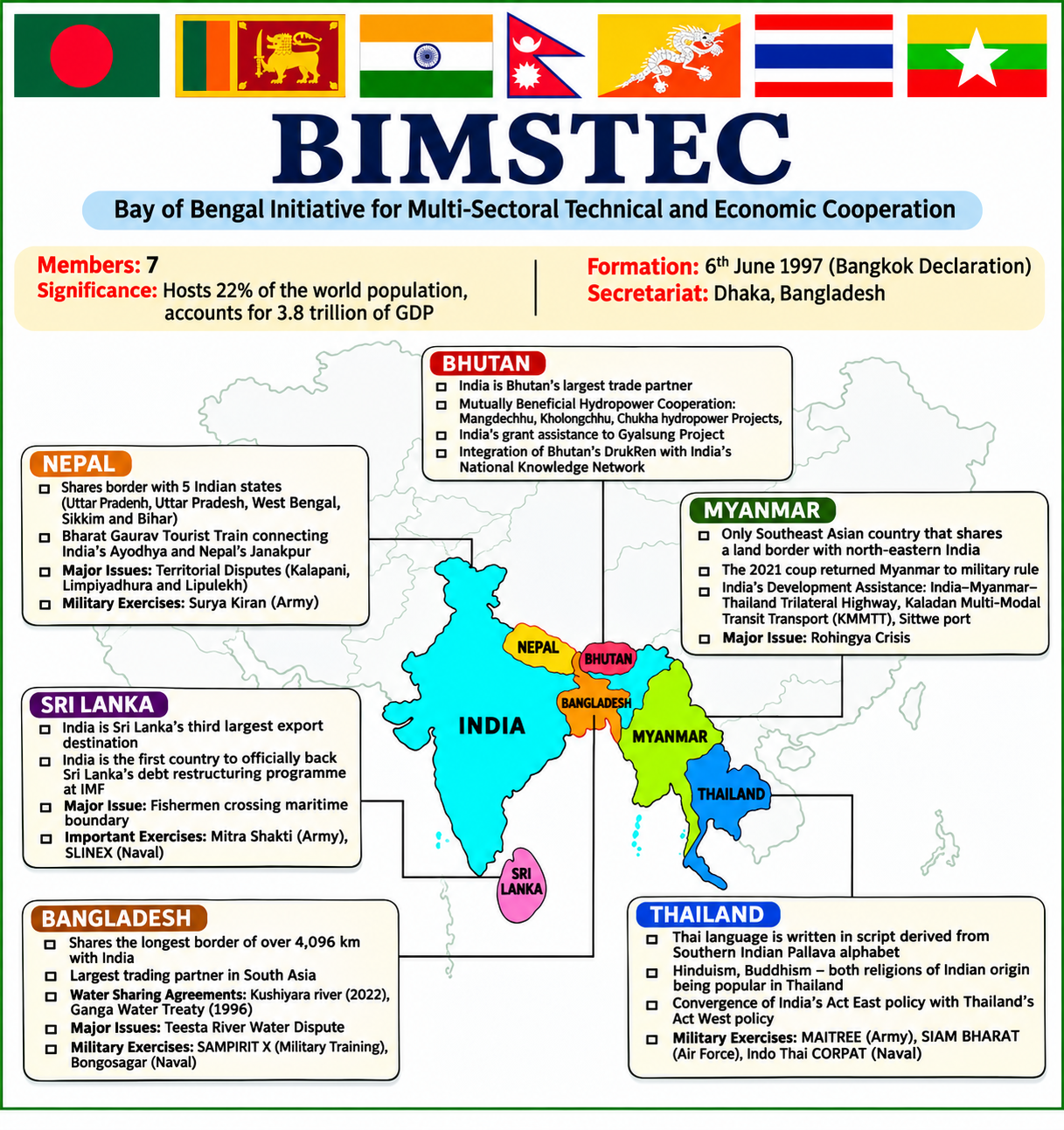
The meeting unanimously adopted a Joint Ministerial Statement and the Revised BIMSTEC Plan of Action on Public Health (2026–2030). The roadmap focuses on disease surveillance, pandemic preparedness, digital healthcare, traditional medicine, antimicrobial resistance, the One Health approach and healthcare workforce development. Members also supported exploring a regional digital health framework covering telemedicine and artificial intelligence in healthcare.
India announced that it would host the BIMSTEC Centre of Excellence in Traditional Medicine at the Institute of Teaching and Research in Ayurveda (ITRA), Jamnagar, Gujarat.
India and Sri Lanka also exchanged an MoU for supplying 100 additional ambulances under Indian grant assistance of approximately USD 5.28 million. India further announced support for 50 medical kiosks to strengthen primary healthcare in Sri Lanka.
The ministers agreed to hold these meetings every two years, with Thailand offering to host the next meeting in 2028. The initiative strengthens regional health security and collective preparedness against cross-border health challenges.
3. One Nation One Ration Card (ONORC)
The One Nation One Ration Card (ONORC) scheme was launched in 2019 by the Department of Food and Public Distribution to ensure nationwide portability of food security benefits under the National Food Security Act (NFSA), 2013. It enables eligible beneficiaries, particularly migrant workers and their families, to obtain subsidised foodgrains from any Fair Price Shop (FPS) across India using their existing ration card.
The scheme operates through Aadhaar-based biometric authentication and electronic Point of Sale (e-PoS) devices. Beneficiaries do not need to obtain a new ration card or pay additional charges when moving to another state. It is implemented under the Integrated Management of Public Distribution System (IM-PDS).
Key Features and Recent Progress
- Implemented across all 36 States and Union Territories.
- Beneficiaries can access their entitled foodgrains through intra-state and inter-state portability.
- The Mera Ration mobile application provides information on entitlements, transaction history and nearby ration shops.
- As of November 2026, more than 233 crore portability transactions have been recorded, distributing over 614 lakh metric tonnes of foodgrains.
- The system promotes transparency, reduces duplication and strengthens food security among migrant populations.
Challenges
Biometric authentication failures, poor internet connectivity, exclusion due to outdated beneficiary records and inadequate awareness continue to affect effective implementation.
ONORC represents an important reform towards an inclusive, technology-enabled and portable public distribution system in India.
FACTS TO KNOW:
Silent Valley National Park
- Silent Valley National Park is located in the Palakkad district of Kerala, in the Western Ghats.
- It covers approximately 237.52 sq. km and forms part of the Nilgiri Biosphere Reserve, India's first biosphere reserve.
- It is one of the remaining relatively undisturbed tropical evergreen rainforest ecosystems in India.
- The name “Silent Valley” is associated with the relative absence of noisy cicadas in the forest.
- The Kunthipuzha River, a tributary of the Bharathapuzha river system, flows through the national park.
- The park is surrounded by the Nilgiri Plateau and the high ranges of the Western Ghats.
- Important tribal communities associated with the region include the Kurumba, Muduga, Irula and Kattu Naiken.
- The vegetation is predominantly tropical evergreen forest.
- It contains more than 1,000 species of flowering plants and numerous orchid species.
- Important fauna include:
- Lion-tailed macaque.
- Nilgiri langur.
- Malabar giant squirrel.
- Asian elephant.
- Bengal tiger.
- Leopard.
- Gaur.
- The lion-tailed macaque is an endangered primate endemic to the Western Ghats.
- The park is also rich in bird diversity, including the great hornbill and Nilgiri wood pigeon.
Recent development
- A butterfly survey recorded three species in Silent Valley National Park for the first time:
- Branded Royal.
- Extra Lascar.
- Orange-spotted Grass Jewel.
- Such surveys help improve documentation of biodiversity and identify changes in species distribution.
Canary Islands
- The Canary Islands are an archipelago in the North Atlantic Ocean, situated off the north-western coast of Africa.
- They are politically part of Spain and constitute one of its autonomous communities.
- Geographically, they are associated with the African continental region.
- They form part of the Macaronesia region, a group of volcanic archipelagos in the North Atlantic.
- The archipelago is situated approximately 100 km from the coast of Morocco.
- It consists of seven major islands and several smaller islands and islets.
- The major islands include:
- Tenerife.
- Gran Canaria.
- Fuerteventura.
- Lanzarote.
- La Palma.
- La Gomera.
- El Hierro.
- Tenerife is the largest and most populated island.
- Mount Teide, located on Tenerife, is Spain's highest point at approximately 3,715 metres.
- The islands are volcanic in origin and contain active volcanic systems.
- The 2021 eruption of the Cumbre Vieja volcanic system occurred on La Palma.
- Many beaches have black volcanic sand.
- The islands are known for their distinctive biodiversity and subtropical climate.
Recent development
- Spain's coastguard rescued 1,488 migrants from 14 boats near the Canary Islands, with many arriving on El Hierro.
- The route across the Atlantic from West Africa to the Canary Islands is a major irregular migration route into Europe.
Mudumalai Tiger Reserve
- Mudumalai Tiger Reserve is located in the Nilgiris district of Tamil Nadu, at the tri-junction of Tamil Nadu, Karnataka and Kerala.
- It forms part of the Nilgiri Biosphere Reserve, established in 1986 as India's first biosphere reserve.
- It is an important component of the Western Ghats landscape and connects several protected forest areas across state boundaries.
- The reserve shares boundaries with:
- Bandipur Tiger Reserve in Karnataka to the north.
- Wayanad Wildlife Sanctuary in Kerala to the west.
- Other forest areas of the Nilgiris landscape to the south and east.
- The terrain is undulating, with elevations ranging approximately from 960 to 1,266 metres.
- The Moyar River flows through the reserve and forms part of its important drainage system.
- The vegetation includes:
- Tropical evergreen forests.
- Moist deciduous forests.
- Moist teak forests.
- Dry teak forests.
- Secondary grasslands and swamps.
- Important plant species include teak, rosewood and bamboo.
- The reserve also contains wild relatives of cultivated plants such as rice, ginger, turmeric and cinnamon.
Fauna
- Mudumalai supports a rich diversity of mammals, reptiles and birds.
- Major mammals include:
- Bengal tiger.
- Asian elephant.
- Indian leopard.
- Gaur.
- Sambar deer.
- Chital or spotted deer.
- Barking deer.
- Four-horned antelope.
- Wild dog or dhole.
- Wild boar.
- It is part of an important elephant and tiger habitat in the Western Ghats–Nilgiri landscape.
- The reserve is connected ecologically with Bandipur and Wayanad, allowing movement of wildlife across state boundaries.
Recent development
- A video circulated on social media showing a state minister pursuing a tiger inside Mudumalai Tiger Reserve.
- The incident raised concerns about disturbance to wildlife and the need to follow wildlife-protection regulations inside protected areas.
Lakhpati Didi Initiative
- The Lakhpati Didi Initiative is a flagship government initiative aimed at strengthening the economic empowerment of rural women associated with Self-Help Groups (SHGs).
- It was announced by the Prime Minister on 15 August 2023.
- The nodal ministry is the Ministry of Rural Development.
- The initiative operates through the institutional framework of the Deendayal Antyodaya Yojana–National Rural Livelihoods Mission (DAY-NRLM).
- A Lakhpati Didi is a woman belonging to an SHG household who earns an annual household income of at least ₹1 lakh, sustained over time.
- The initiative aims to help women establish and expand sustainable livelihood activities and micro-enterprises.
- The original target was to benefit two crore women.
- The target was increased to three crore in the Interim Budget of 2024–25.
- The target was subsequently raised to six crore women by March 2029, as reported in the 2026 update.
Major strategies
- Livelihood diversification: Encourages women to undertake multiple income-generating activities rather than depending on a single source of income.
- Enterprise development: Supports the establishment of small businesses and micro-enterprises in rural areas.
- Skill development: Provides training in business management, financial literacy, marketing and livelihood-related skills.
- Financial inclusion: Facilitates access to bank credit, financial services and government support.
- Market linkage: Helps SHG members connect with markets to sell their products and services.
- Capacity building: Uses a cascade training strategy in which trained community members support and guide other potential Lakhpati Didis.
Possible livelihood activities
- Agriculture and allied activities.
- Dairy farming and animal husbandry.
- Food processing.
- Handicrafts and traditional products.
- Tailoring and garment production.
- Retail and small trading businesses.
- Rural services and other non-farm enterprises.
DAY-NRLM
- DAY-NRLM is a flagship poverty-reduction programme of the Ministry of Rural Development.
- It was launched in 2011 as the National Rural Livelihoods Mission and subsequently renamed.
- Its primary objective is to reduce rural poverty by enabling poor households to access self-employment and skilled wage employment opportunities.
- It promotes the formation and strengthening of women-led SHGs and their federations.
- It facilitates access to bank credit, financial literacy, skill development and sustainable livelihoods.
Recent progress
- According to the 16 November 2026 report, 3.76 crore Lakhpati Didis had been enabled as of June 2026.
- The revised target is six crore women by March 2029.
****
Keywords